
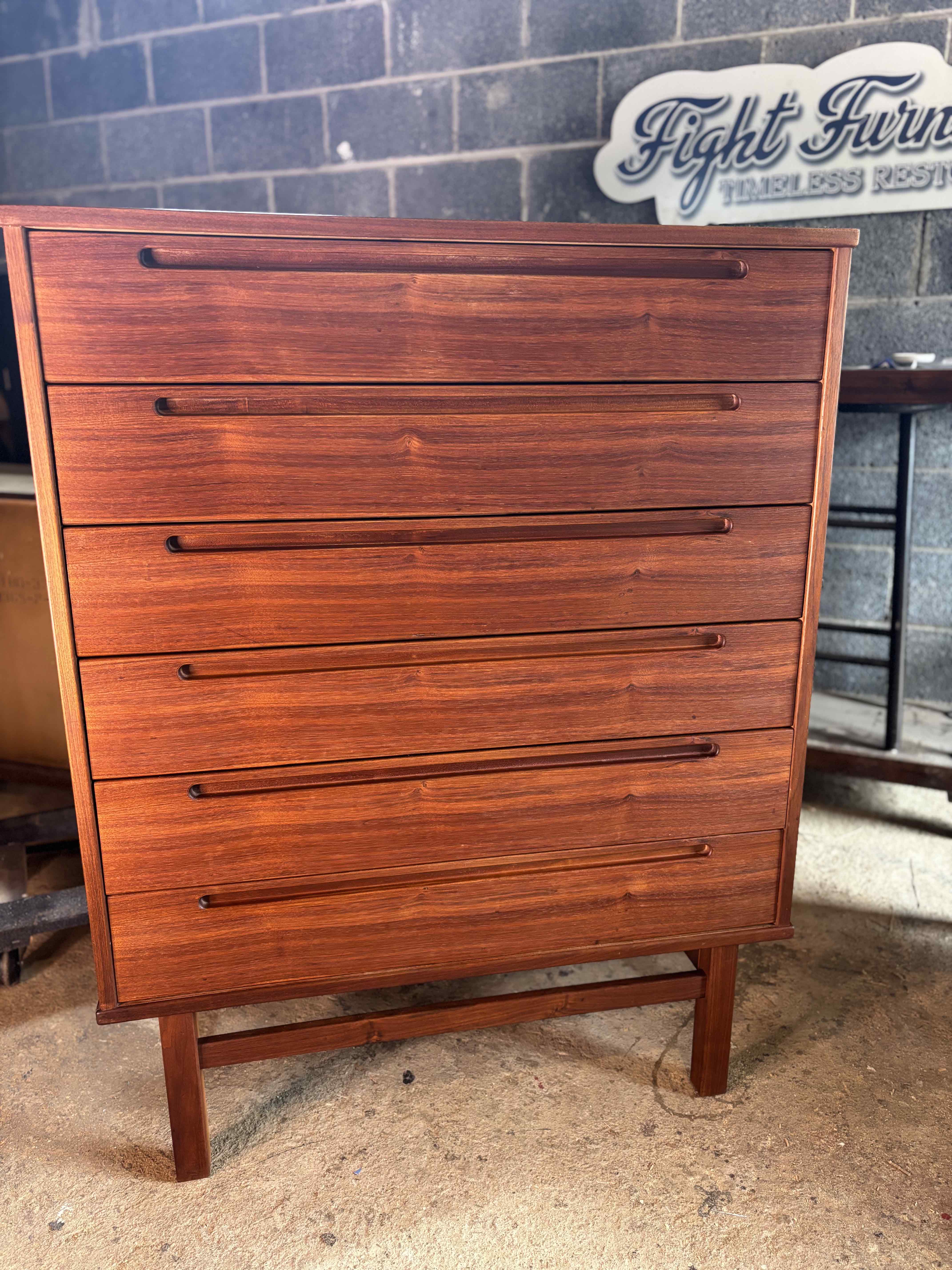

When a piece of teak furniture walks into your shop, you pause, you appreciate, you stare. The light hits it differently, just better, a little warmer. And then it sits there in your shop and waits and waits and waits. Because teak’s beauty is intimidating! You don’t want to mess it up! So you wait, and sometimes, anything you do can feel risky.
A set of Nils Jonsson for Touring Molfabrik dressers appeared in my shop, on commission. Not needing significant repair. Only needing rejuvenation. Sure, there were scratches, a few dings, some water marks, a corner of chipped veneer. But the teakwod was unblemished. And as I professionally refinished the two dressers, I tried my best to keep the teak unblemished.
Today, I’ll show you how I refinished these dressers and brought them back to factory condition, without even sanding them. Seriously.
Step 1: Clean your piece
Grab Simple Green’s All-Purpose Cleaner, dilute it per the bottle’s instructions, then wipe the whole piece down. This serves two purposes: 1) It gets you familiar with the piece and the extent of its damage. You’d be surprised what the eye misses. Touching the piece really helps. 2) It cleans the piece. No surprise here. A clean piece is an easier piece to refinish. Sometimes the scratches and watermarks will wipe right off. Work smart.
Step 2: Strip the piece… sort of
Many Danish Modern pieces are finished with oil alone, either Tung (which is usually just Tung Oil) or Danish Oil (which is combination of oil, stain, and varnish). Both are exceptionally beautiful on teak. And that was the case for my Nils Jonsson for Touring Molfabrik dressers. Oil only.
I sprayed down the drawers separately, then the entire frame of the dresser, with QCS Stripwell’s Finish Remover. I let it sit for 15 minutes, then I wiped down every inch with Steel Wool Grade 0000. In some spots, the previous stains didn’t lift immediately, so I repeated another round of finish remove and steel wool. All of the stains and blemishes lifted. A true Christmas miracle.
If your piece is topcoated with lacquer, you can still use QCS Stripwell to remove the finish. It may take longer and I’d advise using a plastic putty knife to strip back the layers. Some residue of the lacquer will likely remain, hugging tight to the teak, and for this I would come back and utilized Steel Wool Grade 0000.
Step 3: Apply your new finish
I knew the original color of this piece was glorious, so I didn’t dare deviate. I wiped on two rounds of Watco’s Danish Oil, Natural color. Then wiped off the residual oil per the bottle’s instructions. 3 days later, the piece was fully restored. No need for a topcoat, just like the original.
If you’d like a more durable, protective layer, I’d recommend utilizing lacquer. By spray. I have a guide HERE for my process. An easier, still aesthetically pleasing, and durable option is oil-based polyurethane, using Varathane’s Oil-Based Polyurethane.
Check out the more detailed, visual breakdown of my professional refinishing of these dressers, here:
Looking for the right equipment and supplies? Check out my full workshop collection HERE.
(Disclaimer: If you purchase these products using the links above, I may receive a small commission in return from Amazon.)
Leave a Reply